Silvia Stocchetto is an artist whose creative path is nourished by an intimate fusion between science and art, between analytical observation and poetic vision. Her training in Biological Sciences, enriched by a doctorate in Biochemistry and Biophysics, has allowed her to refine a gaze capable of grasping the meticulous texture of the invisible world: cellular textures, mitochondria, organic architectures that constitute the very breath of life. This approach, never abandoned, is transfigured into an artistic sensitivity which, far from limiting itself to the mere reproduction of reality, reveals its secret dynamics, translating them into an original imaginative dimension with surreal features.
To open, in chronological order, the exhibition itinerary of this personal exhibition is Gru coronata (2016), a painting of particular importance in Stocchetto's artistic career. In fact, it establishes the affirmation of a visual grammar destined to become a distinctive feature of her poetics in the following years.
The work imposes itself with an enveloping chromatic force: a warm monochrome pervades the composition, immersing it in a suspended, surreal atmosphere, in which the natural dimension and the imagination intertwine in a fragile and subtle balance.
At the center of the scene, among floating wooden fragments, the enigmatic figure of the crane stands out. His watchful gaze and his elegance make him the fulcrum of the visual narrative, while other animal presences emerge from the pictorial plot, like silent witnesses of an arcane and fragmented universe. The broken wood, with its sharp splinters and its unstable geometries, becomes a symbol of an existence poised between construction and dissolution, between permanence and transience.
Evolution 2 (2018) represents a moment of transition: nature, still free from the solitary aura of the idol that will soon dominate the painter's works, manifests itself here in a pulsating composition with a choral approach. The symbolic dimension of painting merges with a more fluid narrative, in which the landscape becomes a living organism, in continuous metamorphosis.
The gaze enters a dense labyrinth of intertwined branches and vines, a visionary forest where nothing is static. Broken lines and sinuous curves suggest an incessant process of growth and evolution, while the birds merge with the vegetation, becoming part of a vibrant and harmonious ecosystem despite its own chaos. Color is essential in this dynamic: the burnt earth and the browns of the branches contrast with the vivid greens of the vegetation, generating a visual tension that suggests an underground vital flow, a secret pulsation of matter.
In subsequent works, this pictorial language is further defined, giving life to increasingly immersive scenarios, populated by ancestral figures that embody the sacredness of nature. Stocchetto's "idols" emerge as archaic totems, enigmatic presences that transform the landscape into a symbolic space, in which reality is intertwined with the echo of ancient myths.
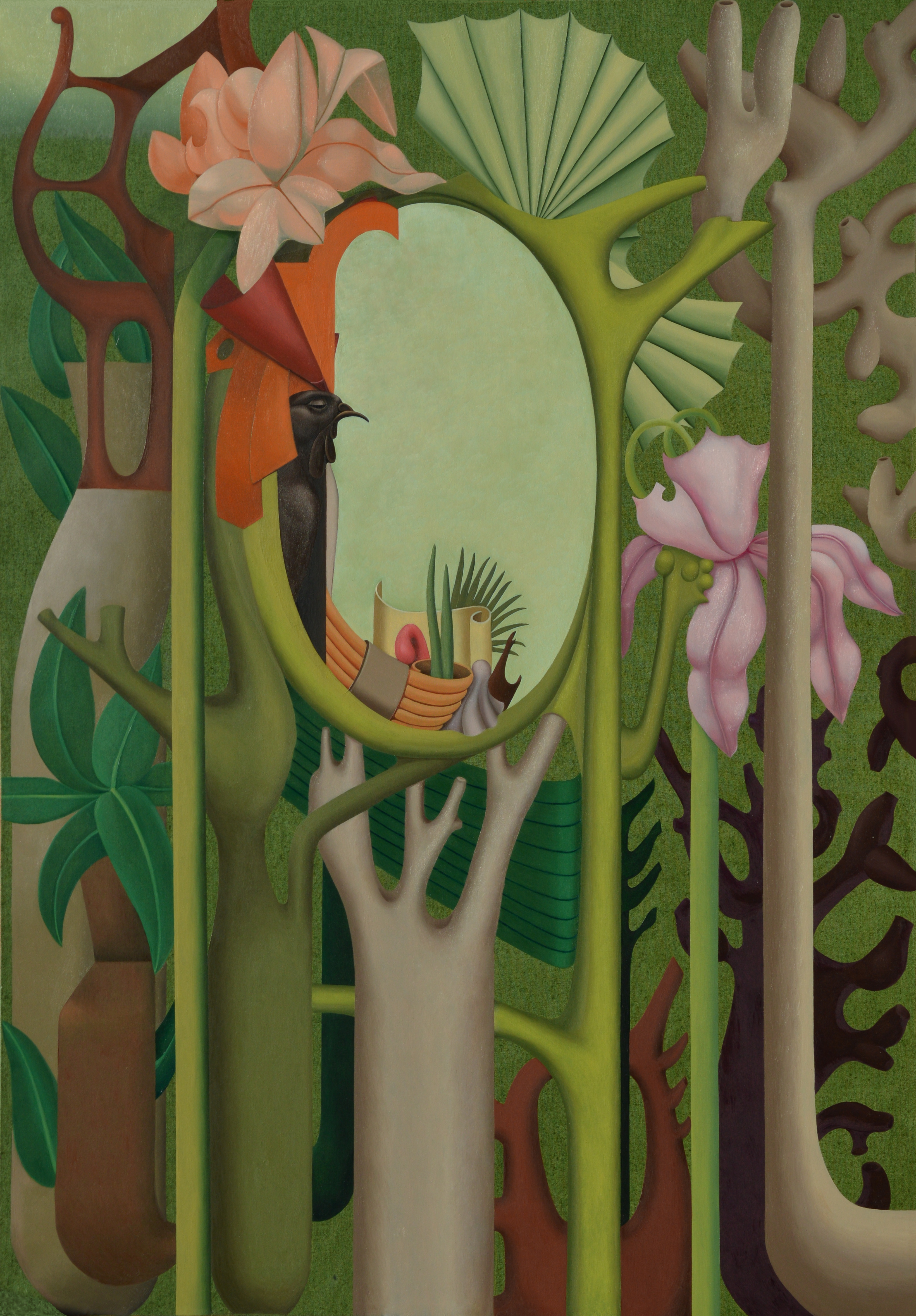
In Idolo (2018), this evolution manifests itself in its full expression. The work marks the start of the poetics of the idol, now become a hieratic icon immersed in a vegetal labyrinth of stylized and sinuous lines. The bird, with its steady gaze and its austere profile, emerges from a dense network of branches and stems that seem to dance in a musical rhythm, suspended between the natural and the dreamlike. The colour, brighter and more vibrant, amplifies the abstract tension of the work: deep ochers and intense greens intertwine in a visual synthesis that unites the organic world with the symbolic one. The idol, although rooted in its animal essence, transcends matter and becomes an emblem, an absolute presence that inhabits a timeless elsewhere.
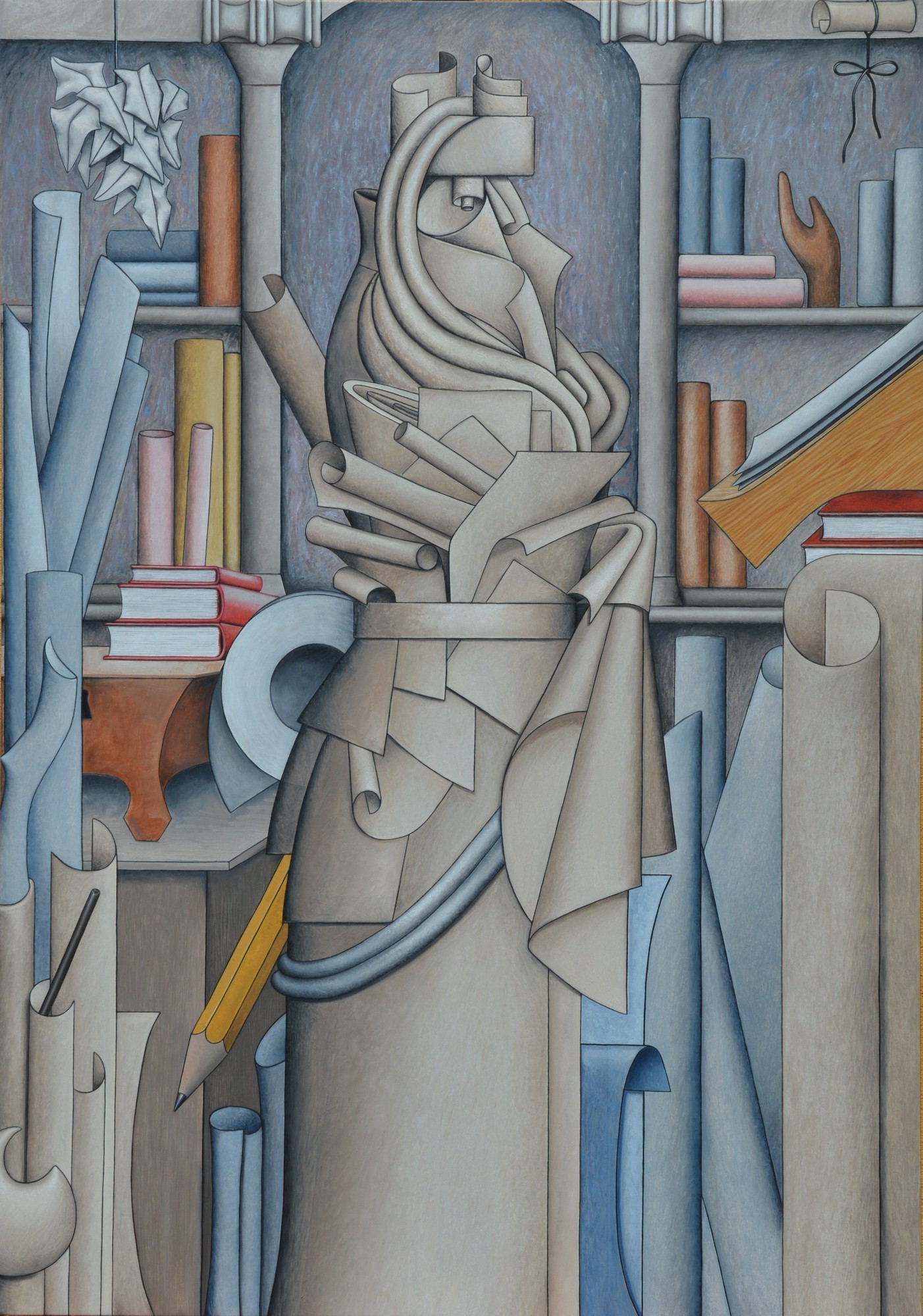
With Idolo X (2021), the artist arrives at a new and further evolution of her language, pushing her research towards territories of a more pronounced surrealist origin. Here the animal figure takes on increasingly anthropomorphic features, dissolving the boundaries between human and natural, between the real and the visionary. The composition, complex and layered, is nourished by further architectural and musical elements that interact with the organic forms, giving life to an enigmatic and magically suspended environment.
The vegetal intertwinings become structures, the bodies hybridize with musical instruments and wooden fragments, outlining an inscrutable metaphysical enigma.
The delicate and sophisticated color palette plays with shades of blue, ocher and earth, enveloping the scene in a vivid diffused light. The idol here is no longer a fixed and solitary icon, but a creature in constant metamorphosis, an entity that defies all classification and invites us to immerse ourselves in a universe of dreams and mystery.
In this dialogue between science and art, between observation and vision, Silvia Stocchetto invites us to look beyond the surface, to immerse ourselves in a universe in which the microscopic becomes immense and the real transforms into a dream. Her idols observe us from a parallel world, witnesses of a nature that is never just what it appears, but which contains within itself the mystery of life itself.